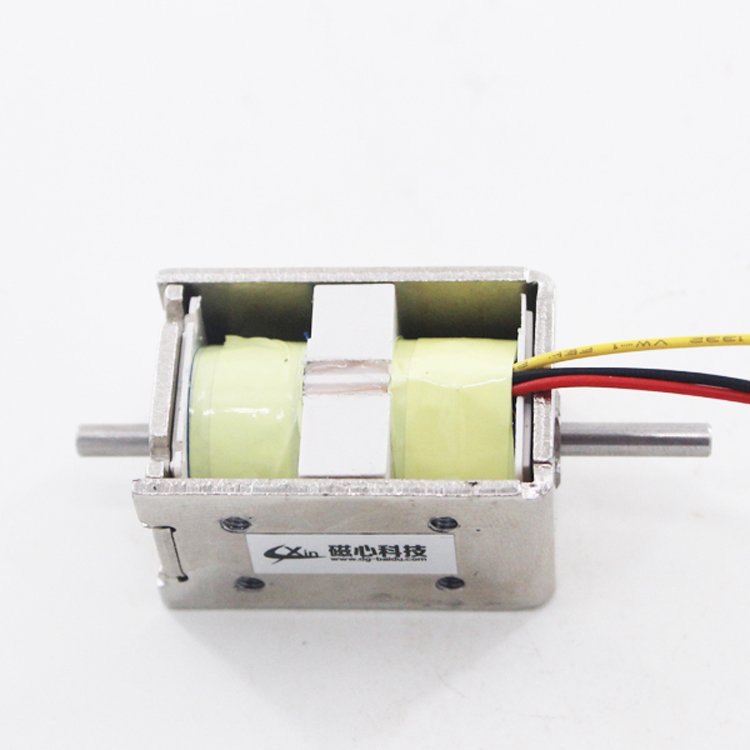
Two ways to end a stroke
Every solenoid mechanism has to answer the same question: when the coil de-energises, what puts the plunger somewhere useful? There are two families of answers. Spring-return designs let a mechanical spring shove the plunger back, and the solenoid holds position only while powered. Bi-stable latching designs use a permanent magnet to hold the plunger at either end of its travel, and the coil fires only to switch states.
Neither answer is universally better. The right choice falls out of three numbers: how often the mechanism cycles, how long it must hold each state, and what the power budget looks like. Get those three clear and the decision almost makes itself.
The energy argument, with real numbers
This is where latching designs earn their premium. Consider a battery-powered cabinet lock that opens once a minute, on a 24 W coil. A spring-return part must be energised for the entire minute the door stands open. A bi-stable part fires a 300 millisecond pulse to unlatch, then the magnet holds the state for free.
A 200-fold difference in coil energy is not a rounding error. It changes the battery spec, the wire gauge, the driver transistor, and the thermal design all at once. For anything that holds a state for minutes or hours, latching is usually the only design that survives the power budget. The reverse is also true: for mechanisms that pulse and release quickly, like a dispenser flap that opens for two seconds and closes, the spring-return part is cheaper and one less failure mode, because there is no magnet stack to demagnetise and no polarity logic to get wrong.
Click noise and cycle life
Latching parts are loud. The magnet stack slams the plunger home hard enough to hold against vibration and shock, and that impact is audible. In a hospital bed, an office access panel or a bedside dispenser, the click can be a usability problem. Mitigations exist, from polyurethane stop washers to driver-side pulse shaping, but they soften the hold force as a side effect, so they are a trade rather than a fix.
Spring-return parts are quieter on the release stroke and produce a softer, more damped sound. On cycle life the comparison is closer than people expect: both families live or die on end-stop management. The latching part's magnet stack adds a component that the spring-return part does not have, but the spring itself is a fatigue part with its own cycle budget. At rated load both families routinely reach one to ten million cycles; the honest number depends on impact velocity and stop design more than on family.
What the driver has to do differently
Spring-return parts need one switch and one flyback diode. The coil energises, the spring does the return, done. Latching parts need polarity reversal to switch states, which in practice means an H-bridge or a dual-coil arrangement. The double-latching part in the photo above carries two coil packs precisely so a single-polarity driver can switch it: pulse one coil to latch, pulse the other to release.
Two consequences follow. First, driver cost rises slightly for latching designs, which matters mostly at high volumes. Second, and more importantly for reliability engineering, the latching mechanism can be switched by an extremely short energy event, which makes it compatible with energy harvesting, capacitor-fired circuits and other exotic supplies that a continuously energised coil could never tolerate.
State memory is the third difference, and it is a real feature rather than a detail. A latching lock remembers its state through a power cut. A spring-return lock fails to a default position when power dies, which is either a safety feature or a security hole depending on which way the default points. Decide that deliberately; do not let it be an accident of the spring.
When we recommend which
After years of field programs, the split has settled into a short rule set that we apply on nearly every enquiry:
Choose latching when the mechanism holds a state for more than a few seconds, especially on battery power. Access panels, metering valves, battery cabinet doors, sleep-mode industrial equipment. The energy chart above is the whole argument.
Choose spring-return when the mechanism pulses and releases, or must fail to a default. Dispensers, sorting flaps, valve venting, anything with a defined safe position. Cheaper, quieter, simpler driver, and the failure mode is predictable.
Choose double-latching when both states must persist. A valve that must remember open through a power cut and closed through the next one. Two coil packs, full state memory, zero holding current in both positions.
The latching family page lists the standard frames, including the KS series in single and double coil layouts, and the duty cycle guide explains the thermal logic that makes pulse-rated coils different. If your mechanism sits on the fence, the fastest way off it is to send the cycle profile to the engineering form; we will run the energy and duty numbers for both options and tell you where each one breaks.
Frequently asked questions
Do latching solenoids use power to hold position?
No. The permanent magnet holds the plunger with zero coil current in either state. The coil fires only to switch states, typically a pulse of 100 to 500 milliseconds. This is the core reason latching parts dominate battery-powered lock and valve designs.
Can a latching solenoid be released without power?
Yes, mechanically, on most designs: a manual release lever or a firm push on the plunger can overcome the magnet, which is why fire-egress hardware favors them. Electrically, releasing needs a reverse polarity pulse, which is why power-cut behaviour must be designed deliberately.
Why are latching solenoids louder?
The magnet stack pulls the plunger home at high velocity and holds it there, so the terminal impact is harder than in spring-damped designs. Stop washers and pulse shaping reduce the noise, at some cost to hold force.
What is the difference between single and double latching?
A single-latching part holds one state magnetically and uses a spring for the other. A double-latching part holds both states magnetically, usually with two coil packs, and keeps its position through power cuts in either direction.